Move · Videos · Technique · 3 min
Stand on One Foot: Balance Exercise for Older Adults
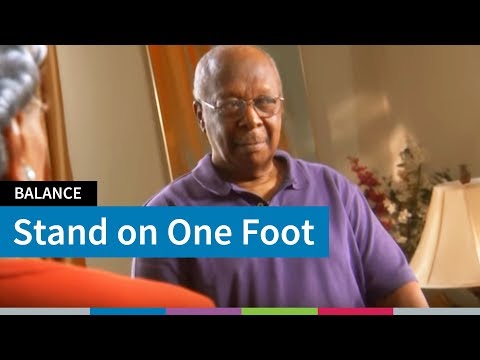
Video by National Institute on Aging on YouTube · Open on YouTube
A trainer coaches three older adults through single-leg standing beside a sturdy chair, table or counter: hold 10 seconds each side, then progress from two hands to one hand to fingertips.
- 3 min
- Beginner
- Low impact (no jumping)
- chair
Good forHealthy ageing
Step by step 5
Tap a time to watch that step in the video.
- Set-up: hold a sturdy chair, table or counter with both hands, feet shoulder-width apart, abs in, head up. 0:03
- Lift one leg and hold for 10 seconds, then lower; 10 to 15 of these is usual. 0:19
- Try it holding on with one hand, the standing knee slightly bent and abs in. 1:03
- Other leg: the same 10-second holds, with a relaxed grip used only for balance. 1:36
- Next progression: fingertips only; keep the standing knee soft, not locked. 2:13
The steps are a summary in our words, checked against the video — the coach shows every move.
Form cues from the coach
- Hold a sturdy chair, table or counter and lift one leg for 10 seconds
- Draw your abs in, shoulders back, head up, with the standing knee slightly soft
- Progress from two hands to one hand, then fingertips
What it works
Tap an area for more videos that work it.
Joints it uses light on the joints
- Hips movesstanding leg holds while the other lifts
- Knees movesstanding knee kept soft
- Ankles & feet movesbalancing on one foot
- Standing on one leg. Keep a chair or a wall within reach.
Easier option from the coach: Hold a chair, table or counter with two hands, then one, then fingertips
A guide to the joints this video’s moves load, from what the coach does — not medical advice. Some ache is normal; stop if a joint hurts sharply. How joints are rated
More like this
 Side-Lying Hip Abduction Done RightWill Harlow – Over-Fifties Specialist Physio · 8 min · beginner
 How to Do a Glute Bridge Without Back PainWill Harlow – Over-Fifties Specialist Physio · 9 min · beginner
 Four Low-Back Stability Exercises: Bridges, Dead Bug, Side PlankRehab Science · 10 min · beginner
 Loop Band Glute Strength: Four Moves From a Physical TherapistMovement & Function · 11 min · beginner
 Top 10 Balance Exercises for Over-50s, RankedBob & Brad · 9 min · beginner
 Four Lower-Body Strength Exercises for Older Adults (NIA)National Institute on Aging · 10 min · beginner
Video by National Institute on Aging; the summary, steps, cues, body areas and joint notes are Notbroken’s, written from what the coach actually does in the video and checked a second time. Warm up first, take the easier options until a move feels easy, and stop if you feel sharp pain, chest pain or dizziness. General instruction, not advice for your body. About & safety