Move · Videos · Technique · 1 min
How to Do a Plank: Form and Building Up to 60 Seconds
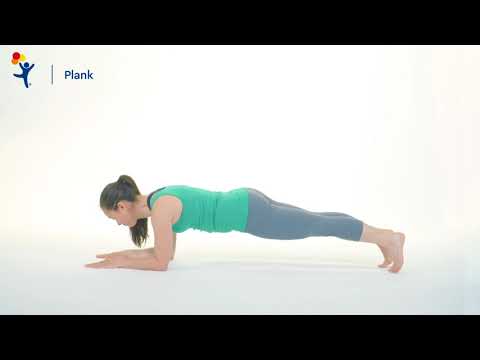
Video by Children's Hospital Colorado on YouTube · Open on YouTube
A children's hospital spine team shows the forearm plank: elbows under shoulders, a straight line from shoulders to heels, short holds that add up to 60 seconds, and a knees-down version if the full plank is too hard.
- 1 min
- Beginner
- Low impact (no jumping)
- No equipment
Step by step 4
Tap a time to watch that step in the video.
- Forearm plank: elbows under your shoulders, palms down, up on your toes in one line from shoulders to heels. 0:01
- Hold for about 10 seconds; stop as soon as your hips dip or you start rolling side to side. 0:11
- Add short holds together to reach 60 seconds, such as four sets of 15, three of 20 or six of 10. 0:32
- Too hard? Do the same plank with your knees on the floor, again building to 60 seconds in total. 0:44
The steps are a summary in our words, checked against the video — the coach shows every move.
Form cues from the coach
- Keep one straight line from your shoulders to your heels
- End the hold as soon as your hips dip or you start rolling side to side
- Add short holds together, such as four sets of 15 seconds, to reach 60 seconds
What it works
Tap an area for more videos that work it.
Joints it uses 1 take load
- Shoulders takes loadforearm plank holds
- Elbows movesforearms on the floor
- Down on the floor. You get down to the floor and back up again.
Easier option from the coach: Plank with the knees down, in short holds that add up to 60 seconds
A guide to the joints this video’s moves load, from what the coach does — not medical advice. Some ache is normal; stop if a joint hurts sharply. How joints are rated
More like this
 How to Plank: Form Cues and ProgressionsE3 Rehab · 4 min · beginner
 Dead Bug: Brace With a Neutral SpineSquat University · 9 min · beginner
 Bird Dog for a Stronger Low BackPhysical Therapy & Hand Clinic of Hillsboro · 5 min · beginner
 Pallof Press With a Band: Five WaysIvana Chapman · 7 min · beginner
 How to Engage Your Deep Core in 3 StepsMichelle Kenway · 6 min · beginner
 McGill Big 3 Core Exercises: Bird Dog, Side Plank, Curl-UpEdmonton West Primary Care Network · 6 min · beginner
Video by Children's Hospital Colorado; the summary, steps, cues, body areas and joint notes are Notbroken’s, written from what the coach actually does in the video and checked a second time. Warm up first, take the easier options until a move feels easy, and stop if you feel sharp pain, chest pain or dizziness. General instruction, not advice for your body. About & safety