Move · Videos · Strength · 51 min
51-Minute Full-Body Bodyweight Strength and Power Workout
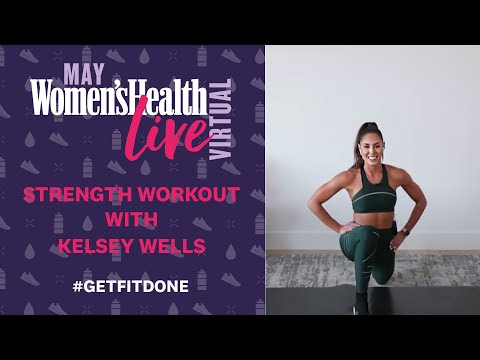
Video by Women's Health UK on YouTube · Open on YouTube
Certified personal trainer Kelsey Wells leads a warm-up, two activation circuits, a jump-lunge, inchworm push-up and ab-bike circuit, glute and core supersets and a plank and squat-hold burnout, then a cool-down. Low-impact and easier options are shown throughout.
- 51 min
- All levels
- High impact (jumping)
- mat
Step by step 10
Tap a time to watch that step in the video.
- Warm-up: jog on the spot, shoulder squeezes and arm circles, then downward dog with calf pumps. 4:03
- Activation 1, three rounds of 30 seconds each: jumping jacks and sumo squats, knees in line with your toes. 6:31
- Activation 2, three rounds: step hops (or step taps for low impact) and dead bugs, lower back pressed down. 10:50
- Circuit demo, then lap 1, 40 seconds each: jump lunges (or reverse lunges), inchworm push-ups and ab bikes. 15:42
- Circuit laps 2 and 3: the same three moves, with 30 seconds' rest between laps. 21:53
- Superset demos: sumo double-pulse jump squat (land softly), glute bridge opener, leg raises and X plank. 28:48
- Superset 1, three rounds of 30 seconds: sumo double-pulse jump squats (or no jump) and glute bridge openers. 32:35
- Superset 2, three rounds: leg raises, lower back pressed to the mat (knees bent if needed), then slow X planks. 38:40
- Burnout: a 60-second low plank (knees down if needed), then 60 seconds of squat holds and pulses. 43:35
- Cool-down: easy steps side to side, a kneeling hip flexor stretch each side, then shoulder and triceps stretches. 46:35
The steps are a summary in our words, checked against the video — the coach shows every move.
Form cues from the coach
- Take out the jump and step or reverse-lunge instead if you need low impact
- Keep your lower back pressed to the mat during dead bugs and leg raises
- In sumo squats send your hips back and keep your knees in line with your toes
What it works Whole body
Tap an area for more videos that work it.
Joints it uses 6 takes load
- Shoulders takes loadinchworm push-ups, X planks, 60 s plank
- Elbows takes loadinchworm push-ups, forearm plank
- Wrists & hands takes loadpush-ups, high-plank X planks, down dog
- Hips takes loadlunges, sumo squats, squat hold, bridges
- Knees takes loadjump lunges, jump squats, sumo squats, jacks
- Ankles & feet takes loadjumping jacks, step hops, jump lunges and squats
- Neck moveshead lifted in ab bikes
- Lower back movesleg raises, ab bikes
- Jumping or hopping. Impact goes through the ankles, knees and hips.
- Kneeling. Pressure on the kneecaps — a folded towel or cushion under the knees helps.
- Weight on your hands. The wrists bend back under load. Fists, push-up handles or your forearms ease it.
- Down on the floor. You get down to the floor and back up again.
- Rounding or twisting the back. With osteoporosis or a back problem, move smoothly and within comfort, and ask a physio which suit you.
Easier option from the coach: Step taps, reverse lunges and squats without the jump; knee push-ups; bent-leg raises
A guide to the joints this video’s moves load, from what the coach does — not medical advice. Some ache is normal; stop if a joint hurts sharply. How joints are rated
More like this
 34-Minute Intermediate Full-Body Bodyweight Circuit WorkoutSWEAT · 34 min · intermediate
 30-Minute Beginner Bodyweight Workout (No Jumping)Joanna Soh Official · 33 min · beginner
 35-Minute Full Body Kettlebell Strength (Low Impact)nourishmovelove · 38 min · intermediate
 40-Minute Intermediate Full-Body Calisthenics and Core WorkoutHeather Robertson · 40 min · intermediate
 45-Minute Full-Body Dumbbell Pump Class with Tempo WorkNuffield Health · 46 min · intermediate
 Strength Routine From a Cardiac Rehab Exercise PhysiologistCleveland Clinic · 10 min · all levels
Video by Women's Health UK; the summary, steps, cues, body areas and joint notes are Notbroken’s, written from what the coach actually does in the video and checked a second time. Warm up first, take the easier options until a move feels easy, and stop if you feel sharp pain, chest pain or dizziness. General instruction, not advice for your body. About & safety